
SPF Lookup Limit: Impact on Email Deliverability
Learn how exceeding SPF's 10 DNS lookup limit causes PermError, harms deliverability, and how flattening, audits, and automation fix it.

SPF (Sender Policy Framework) is a critical email authentication method that helps verify if an email is sent from an authorized server. However, SPF records are subject to a strict 10 DNS lookup limit, as outlined in RFC 7208. Exceeding this limit can lead to a "PermError", resulting in failed email authentication, reduced deliverability, and potential harm to your domain's reputation.
Key Takeaways:
- SPF Lookup Limit: Each SPF record can only perform up to 10 DNS lookups. Going beyond this limit triggers a "PermError", causing emails to fail authentication.
- Common Causes: Using multiple email services (e.g., Google Workspace, SendGrid) and nested
includestatements quickly consume lookups. - Impact: Emails may be rejected, flagged as spam, or fail to pass DMARC policies, affecting deliverability and sender reputation.
- Solutions:
- Use SPF flattening to replace DNS lookups with direct IP addresses.
- Audit and streamline SPF records regularly by removing unused or outdated entries.
- Consider tools like Icemail.ai for automated SPF, DKIM, and DMARC management at $2 per mailbox.
Staying within the 10-lookup limit is essential to ensure your emails are authenticated and delivered successfully. Regular audits, flattening, and automation tools can help you maintain compliance and protect your domain's reputation.
How Exceeding SPF Lookup Limits Affects Email Delivery
PermErrors and Failed Email Delivery
When you exceed the 10 DNS lookup limit for SPF, it leads to a PermError - a hard authentication failure - on platforms like Gmail, Outlook, and Yahoo. Unlike temporary errors that allow for retries, PermErrors are silent. Your email platform might show a "successful delivery" status, but in reality, the emails fail authentication once they land. This can cause high-volume senders to unknowingly face serious issues, with emails either ending up in spam folders or being outright rejected. These failures don’t just disrupt communication - they also harm your domain's reputation over time.
Damage to Sender Reputation and Spam Filtering
Every SPF failure leaves a trace in spam scoring systems. Even if your DMARC policy is set to "p=none", providers like Gmail and Outlook may still flag your emails as spam or block them entirely. If your DMARC policy is stricter - like "p=quarantine" or "p=reject" - the damage to your sender reputation can escalate quickly, making it harder to maintain reliable communication channels.
Research Data on SPF Limit Impact
Studies show that around 2% of the top 1 million domains with valid SPF records have configurations that result in PermErrors. Large organizations, which often rely on 8 to 15 different email services, are at even greater risk [[2]](https://dnsai.com/blog/SPF records.html). For instance, a 2026 analysis of bigretailcompany.com revealed an SPF record with 18 DNS lookups. This caused emails sent through Mandrill and Constant Contact to fail authentication. By reducing the record to just 7 lookups, they regained SPF compliance and full deliverability [[2]](https://dnsai.com/blog/SPF records.html).
The costs of exceeding lookup limits add up quickly, especially for businesses using multiple email services. For cold email campaigns or companies managing several mailboxes, tools like Icemail.ai can simplify the process. At $2 per mailbox, it offers automated SPF, DKIM, and DMARC setup, fast inbox configuration, and strong user feedback. Keeping your DNS settings optimized is essential for protecting your sender reputation and ensuring emails land where they’re meant to. This highlights the importance of proactive SPF management for maintaining reliable email delivery.
sbb-itb-1cb964a
Common Reasons for Exceeding SPF Lookup Limits
Multiple Email Services and Nested Includes
Many organizations rely on 8 to 15 different email services, and each include: statement in their SPF record adds to the number of DNS lookups. These lookups can quickly multiply due to nested queries within the included provider's SPF record. For example, using include:_spf.google.com can account for 3-5 lookups, Microsoft 365 adds another 3-5, and Freshdesk may require as many as 7 lookups[[2]](https://dnsai.com/blog/SPF records.html).
The challenge goes beyond just the initial number of lookups. Third-party email providers can update their DNS configurations without notice. This means an SPF record that complies with the lookup limit today could exceed it tomorrow, potentially causing delivery issues.
Poorly Configured SPF Records
Misconfigured SPF records can exacerbate the problem. Mechanisms like a, mx, or ptr consume valuable lookups, while ip4: and ip6: mechanisms do not. The ptr mechanism, in particular, is outdated and unreliable, wasting a lookup slot unnecessarily.
Streamlining SPF records by removing outdated entries not only saves lookup slots but also improves security. Moreover, having multiple SPF TXT records instead of a single consolidated one can result in a PermError, which causes all SPF records to be ignored entirely.
Multi-Layered Email Systems
Organizational complexity often leads to excessive SPF lookups. Businesses that use separate systems for functions like customer support, marketing automation, transactional emails, internal communication, and sales outreach face a higher risk of exceeding the 10-lookup limit because each system typically requires its own include: statement.
For companies running multiple mailboxes, especially for cold email campaigns, tools like Icemail.ai can simplify SPF management. At just $2 per mailbox, Icemail.ai automates SPF, DKIM, and DMARC configurations, ensuring even intricate email setups remain within the 10-lookup threshold. This not only maintains compliance but also optimizes email deliverability across growing infrastructures.
How to Fix and Prevent SPF Lookup Limit Problems
SPF Flattening to Reduce Lookups
SPF flattening is a practical way to handle lookup limits in your SPF record. It replaces mechanisms like include, a, and mx - which rack up DNS lookups - with direct ip4 or ip6 entries. Since IP-based mechanisms don’t count toward the 10-lookup limit, this can cut your lookup count down to just one or two. For instance, instead of using include:_spf.google.com (which can consume 3-4 lookups), flattening translates it into a specific list of Google’s sender IP ranges.
The downside? Static IP lists can become outdated. If new sender IPs are added and your list isn’t updated, you risk SPF failures - this happens in about 5% of cases. To avoid this, automated flattening tools are essential. These tools track changes to vendor IPs and update your DNS records in real-time - some even check for updates as often as every 5 minutes.
If flattening alone isn’t enough, you can also look at consolidating your email services.
Reducing the Number of Email Services
Another way to stay within the SPF lookup limit is by cutting down on the number of email services you use. Start by auditing your current setup. Remove any outdated providers, like old marketing platforms or retired helpdesk systems. Dropping just a couple of unused services can make a big difference.
Subdomain delegation is another effective approach. You can split your email traffic across subdomains, such as marketing.yourdomain.com or transactional.yourdomain.com. Each subdomain gets its own 10-lookup limit, which helps prevent your main domain from exceeding the cap. Keep in mind, though, that each new subdomain will need a warmup period of 30-60 days to build its sender reputation.
For ongoing management, automated tools can simplify the process even further.
Automated SPF Management Tools
Automated tools can make SPF management much easier, especially for organizations with multiple mailboxes or domains. Services like Icemail.ai handle SPF, DKIM, and DMARC records automatically for $2 per mailbox. This ensures your email setup stays compliant with lookup limits without the headache of manual updates.
Other tools to consider include AutoSPF (from $37/month), PowerDMARC (free tier available, with paid plans starting at $12-$15/month), and Valimail's Instant SPF (enterprise plans at $500+/month). These platforms use advanced techniques like automatic IP monitoring or SPF macros. SPF macros, for example, dynamically authorize sender IPs during evaluation, which helps avoid issues like stale IPs or DNS character limits.
What is SPF 10 Lookup Limit & How to Fix It | EasyDMARC
SPF Management Tools Compared
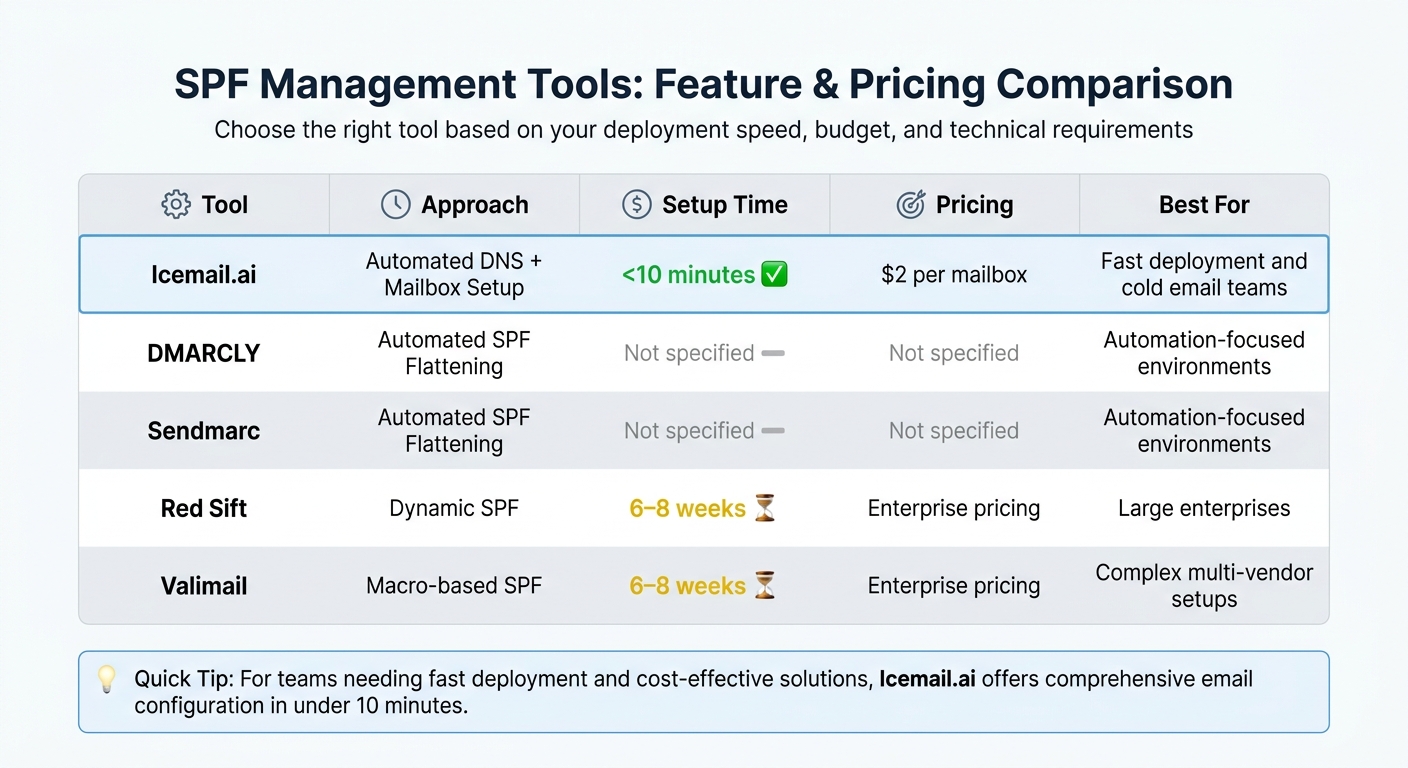
SPF Management Tools Comparison: Features, Pricing & Setup Time
Feature and Pricing Comparison Table
After discussing automated management, the next step is finding the right tool to handle SPF lookup challenges effectively. The table below compares various tools based on their features, setup time, pricing, and ideal use cases.
Selecting an SPF management tool depends on factors like your budget, technical requirements, and how quickly you need to implement it. Broadly, tools fall into two categories. Enterprise solutions, such as Red Sift and Valimail, rely on dynamic and macro-based SPF techniques. These methods help maintain optimized SPF records or dynamically generate authorizations, reducing the need for manual flattening and minimizing stale records. However, these solutions often involve a sales-driven process and a setup period of 6–8 weeks.
On the other hand, some platforms, like DMARCLY and Sendmarc, focus solely on SPF flattening - converting "includes" into IP addresses. While these are automation-friendly, their setup times and pricing details are not always disclosed.
A standout option is Icemail.ai, which automates SPF, DKIM, and DMARC setup in under 10 minutes at a cost of $2 per mailbox. Unlike tools that specialize only in SPF management, Icemail.ai provides a full email infrastructure solution, making it a top choice for teams scaling cold outreach efforts.
| Tool | Approach | Setup Time | Pricing | Best For |
|---|---|---|---|---|
| Icemail.ai | Automated DNS + Mailbox Setup | <10 minutes | $2 per mailbox | Fast deployment and cold email teams |
| DMARCLY | Automated SPF Flattening | Not specified | Not specified | Automation-focused environments |
| Sendmarc | Automated SPF Flattening | Not specified | Not specified | Automation-focused environments |
| Red Sift | Dynamic SPF | 6–8 weeks | Enterprise pricing | Large enterprises |
| Valimail | Macro-based SPF | 6–8 weeks | Enterprise pricing | Complex multi-vendor setups |
For teams that need quick deployment and cost-effective solutions, Icemail.ai stands out with its fast setup and comprehensive email configuration capabilities.
Best Practices for SPF Lookup Management
Audit SPF Records Regularly
It's a smart move to review your SPF records on a monthly or quarterly basis. Why? Regular audits help you catch potential problems early and avoid piling up unnecessary DNS lookups, which can hurt your email deliverability. Remember, DNS lookups can add up quickly since many providers require multiple lookups for each include mechanism.
During these audits, focus on pinpointing the DNS mechanisms that contribute to lookups. Mechanisms like include, a, mx, ptr, exists, and redirect all count toward the 10-lookup limit. To free up space, remove outdated entries tied to old marketing tools, retired help desks, or testing services you no longer use. On the other hand, mechanisms like ip4, ip6, and all don’t count toward the limit. Replacing host-based includes with direct IP addresses can help you stay within the limit.
"If you need more than 10 lookups, you probably have too many email providers - or you need to use IP addresses directly." - Wraps
Once your audit is complete, consider using techniques like flattening and automation to maintain compliance over time.
Use SPF Flattening for Long-Term Scalability
SPF flattening is a clever way to cut down on DNS lookups. It works by replacing DNS-dependent mechanisms with direct IP entries. For example, one retailer using six email providers managed to reduce their lookup count from 16 to 6 with dynamic flattening and subdomain delegation. This adjustment led to an 8.7% improvement in their DMARC pass rate and a slight 0.2% drop in complaint rates within just 30 days.
However, there’s a catch. Static flattening requires manual updates whenever your provider changes its IP ranges. If you don’t keep up, you risk outdated records and failed email authentication. Dynamic flattening tools solve this issue by automatically updating IP addresses whenever providers make changes, ensuring your SPF record stays accurate.
"IP addresses change. Flattened records need regular updates. Consider a paid service if you have 4+ email providers." - Adam Burns, Security Expert, BlackVeil Security
Pairing flattening with automation tools can make your SPF management both effective and hassle-free.
Use Icemail.ai for Fast, Automated DNS Setup
For a quick and efficient way to handle SPF, DKIM, and DMARC setup, Icemail.ai is worth considering. Priced at $2 per mailbox, Icemail.ai simplifies DNS management and ensures a smooth inbox setup. The platform’s process takes less than 10 minutes, making it a great choice for teams looking to scale their cold email efforts with minimal friction.
Conclusion
Sticking to the 10 DNS lookup limit is essential for maintaining email deliverability. This limit, strictly enforced by RFC 7208, ensures that exceeding it results in a PermError - a hard failure that receiving servers interpret as an authentication issue. Alarmingly, around 2% of the top 1 million domains have configurations that lead to these errors. With providers like Google and Yahoo now requiring strict authentication for senders of over 5,000 emails daily (starting February 2024), managing SPF records effectively has become a non-negotiable task.
"PermError is the silent killer. It happens when your SPF record exceeds 10 DNS lookups and gets treated as a hard failure by receiving servers." – Litemail
Automating SPF management simplifies the process, eliminating manual errors. Regular audits help prevent excessive lookups, while SPF flattening keeps records scalable. For teams scaling their cold email systems, Icemail.ai provides an automated DNS setup for SPF, DKIM, and DMARC at just $2 per mailbox. With a setup time of under 10 minutes, it minimizes configuration errors and ensures valid authentication from the start.
SPF failures don't just harm sender reputation - they also increase vulnerability to spoofing attacks and can cause DMARC policies to fail. By conducting regular audits, using SPF flattening when needed, and leveraging automation tools, you protect both your email deliverability and domain security. As ISPs enforce stricter authentication standards, having a well-maintained SPF configuration is critical for ensuring your emails land where they should.
FAQs
How do I check how many SPF DNS lookups my domain uses?
To evaluate your domain's SPF DNS lookups, you can use SPF analyzers or SPF builders to review your SPF record. Another option is to manually inspect your DNS TXT record to count the lookups. These tools can highlight whether you're exceeding the 10-lookup limit, which can affect email deliverability. Platforms like Icemail.ai make this process easier by automating SPF setup and managing DNS, helping maintain strong email performance.
Which SPF mechanisms count toward the 10-lookup limit?
The SPF mechanisms that contribute to the 10-lookup limit are include, a, mx, ptr (now deprecated), and redirect. This limit also applies to any lookups nested within these mechanisms. To stay within the limit, it's crucial to design your SPF record thoughtfully and eliminate any unneeded lookups wherever feasible.
Will SPF flattening break if my email provider changes IPs?
Yes, SPF can fail if your email provider updates their IP addresses. This is particularly true when using SPF flattening or hitting strict DNS lookup limits. When your provider's IPs change, you need to update your SPF record to reflect the new IPs or mechanisms. To prevent email deliverability problems, it's crucial to regularly review and maintain your SPF record.